
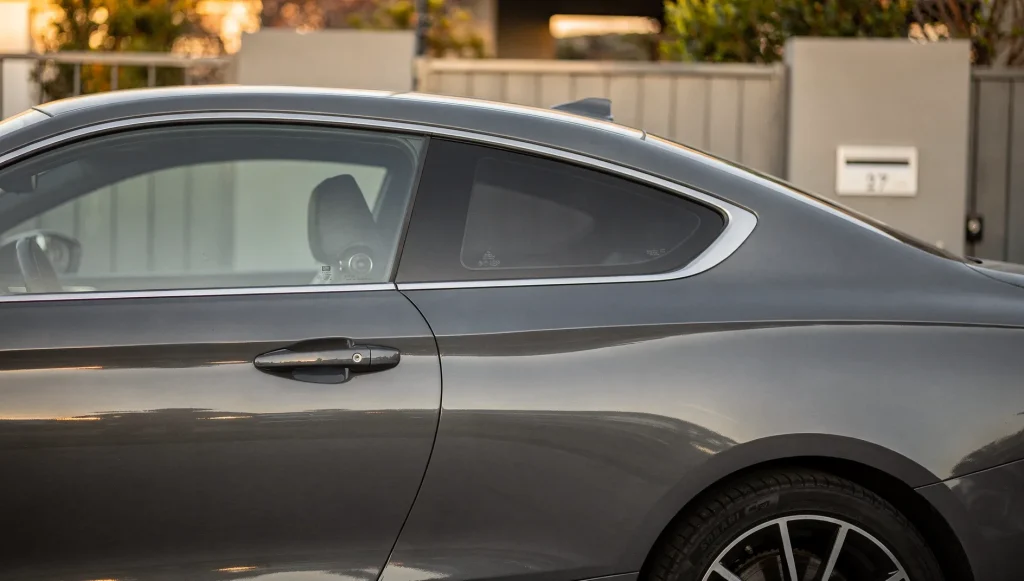
Picture a typical Perth forecourt mid-morning. Rows of stock sit nose-to-tail, the sun is already high, and glare is bouncing off every bonnet and windscreen in sight. This is exactly the environment where photographing cars at a dealership forecourt in Perth gets difficult, and it’s where a professional dealership car photography service earns its value. The challenge isn’t the car itself. It’s the uncontrolled conditions around it.
Unlike a studio bay or a controlled setting, the forecourt gives you harsh light, reflective surfaces and visual clutter all at once. The good news is that each of these problems has a practical solution if you understand how to read the conditions and position accordingly.
Prefer to watch or listen?
Listen onApple Podcasts
Reading the Perth Sun
Light is the first thing to get right. Midday sun sits almost directly overhead, which flattens the car’s shape and dumps hard shadows under the mirrors, sills and arches. It also creates bright hotspots on horizontal panels that blow out detail in the paint.
The softest, most flattering light comes early and late in the day. Shooting in the first couple of hours after sunrise or the last couple before sunset gives you lower-angle light that wraps around the body and shows off its lines. Overcast days are not the enemy either. A thin layer of cloud acts like a giant diffuser, evening out the light across the whole car and making reflections far easier to manage.
If you must shoot in strong midday sun, look for open shade. Positioning the car beside a building or under consistent cover removes the harsh overhead glare while keeping the light even.
Taming Reflections on Paint and Glass
Reflective paint and glass are a constant problem on a forecourt because every surface mirrors whatever is around it. The sky, nearby vehicles, signage and even the photographer can all appear in the shot.
Angle is your main tool. Small shifts in where you stand relative to the car and the sun change what the panels reflect. Walk the car and watch the paint before you commit to a position. The aim is to keep the brightest sources of glare off the main body panels.
- Keep the sun behind or to the side of you rather than directly in front, so it lights the car instead of bouncing straight back into the lens.
- Watch the windscreen and side glass for reflections of yourself, equipment or other cars, and adjust your height or angle to clear them.
- Use the car’s curves to your advantage. Softer reflections on a rounded panel read better than a hard mirror image on a flat one.
- A polarising filter cuts glare on glass and dulls hotspots on paint, giving richer colour.
Managing Surrounding Stock
On an active forecourt the subject car rarely sits alone. Other vehicles crowd in behind and beside it, competing for attention. The job is to isolate the car you’re selling so the viewer’s eye goes straight to it.
Where possible, move the car into a clearer pocket of the lot or pull it slightly forward so there’s space behind it. A longer focal length and a wider aperture help here too, softening the background so neighbouring stock falls out of focus. Choosing your angle carefully — shooting across an open corner rather than down a packed row — keeps distracting vehicles out of frame entirely. The same thinking that goes into choosing a clean backdrop applies on the forecourt: you’re controlling what sits behind the car even when you can’t control the setting itself.
Working Around Forecourt Obstacles
Signage, bollards, light poles, price boards and foot traffic all find their way into frames if you let them. Before shooting, walk the full circle around the car and note what sits in the background from each angle.
Often a small repositioning solves it. Turning the car ten or fifteen degrees, or stepping to one side, can hide a pole behind the pillar or move a bollard out of shot. Keep an eye on reflections of these obstacles too, not just their direct appearance. On a busy lot, timing your captures between customers and staff movement keeps people out of the image.
Camera and Lens Choices for the Forecourt
A phone can take a usable snapshot, but it struggles with the exact conditions the forecourt throws at you. Wide phone lenses distort the car’s proportions, and small sensors handle the extreme contrast of bright sun and deep shadow poorly, clipping detail in both.
A proper camera gives you more control where it matters:
- Interchangeable lenses let you choose a focal length that keeps the car’s proportions natural and separates it from the background.
- A larger sensor holds detail in both the bright panels and the shaded areas of the same frame.
- Manual control over exposure keeps a run of images consistent, so a whole listing looks like it belongs together.
- Filters, such as a polariser, screw onto a real lens to manage glare at the point of capture.
Consistency across every car in an online gallery is what separates a professional set from a collection of one-off phone shots.
A Repeatable On-Site Sequence
Working to a routine means every car gets the same treatment regardless of how hectic the lot is. A reliable sequence looks like this:
- Position the car in the cleanest available spot with the best light and the least clutter behind it.
- Walk the full circle to check reflections, obstacles and background before raising the camera.
- Capture the hero three-quarter front angle first, then the side, rear three-quarter and straight-on views.
- Move in for detail shots — wheels, badges, lights — keeping reflections under control.
- Finish with the interior, shading the glass where you can to reduce glare on the dash and screens.
Following the same order every time produces a complete, sale-ready set with nothing missed.
Even a perfectly shot forecourt gallery has a shelf life. Stock turns over quickly, a car that sold weeks ago can still be fronting the listings, and images that looked current slowly go stale. That raises a practical question about keeping a dealership’s photos current as stock changes, and it’s worth thinking through before the gallery drifts out of date.