
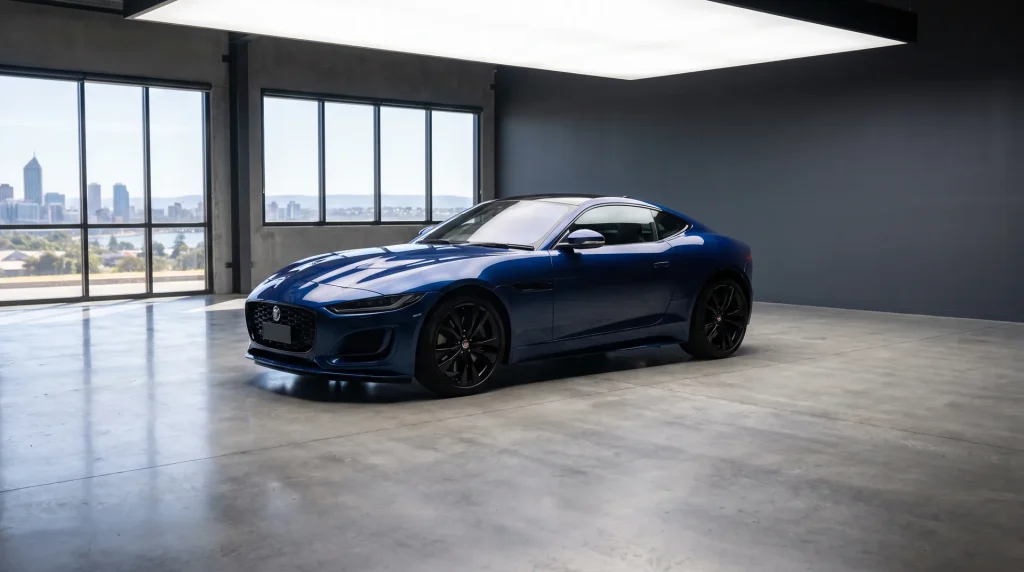
Almost everyone now carries a capable camera in their pocket. Phone sensors are sharp, the software is clever, and a quick photo in a driveway looks fine on a small screen. So sellers reasonably ask: does a phone really fall short? To answer that, it helps to understand what genuinely separates a quick phone shot from professional car photography in Perth, WA on a technical level, rather than just assuming one looks better than the other.
This is not about which image makes a buyer act. It is about why the output differs at all. The reasons are physical and they come down to how light, lenses and processing interact with a large, curved, reflective object.
Lighting Control on Reflective Surfaces
A phone works with whatever light happens to be present. Harsh midday sun, patchy cloud, a streetlight, a garage globe. The phone reacts to that light but cannot change it. On a flat subject this is forgivable. On a car it is not, because paint and glass behave like mirrors.
Professional work starts by shaping and balancing light rather than accepting it. That can mean choosing the time of day, the direction the car faces, the surrounding surfaces that bounce light back, or added lighting that fills shadows evenly. The goal is a smooth, controlled gradient across each panel instead of one bright hotspot and one dead-dark side.
Reflections and Panel Glare
Curved metal and glass reflect everything around them. A phone photo taken without thought often shows the photographer, nearby fences, power lines, or a cluttered carport draped across the bonnet and doors. Those reflections compete with the car itself.
Under controlled conditions, reflections are managed deliberately. The car is positioned so panels pick up clean, even tones rather than messy surroundings. Glare across the windscreen and chrome is reduced by angle and light direction. The result is a surface that reads as smooth and glossy instead of busy and distracting.
Lens, Perspective and Distortion
Most phones default to a wide-angle lens. Wide angles are great for tight spaces but they bend straight lines, especially near the edges of the frame. Get close to a car and the nearest corner balloons while the far end shrinks. Body lines curve, wheels look mismatched, and the proportions feel wrong even if you cannot say why.
Choosing the right focal length corrects this. A longer lens, used from further back, compresses the scene and keeps the car’s proportions honest. Doors, panels and wheel arches sit in their true relationship to one another. The car looks like itself.
Dynamic Range and Detail Retention
Cars routinely contain extreme contrast in a single frame: a bright sky, deep shadow under the arches, a dark interior through the glass, and reflective chrome all at once. Phones try to balance this automatically, but they often blow out the highlights or crush the shadows to get an average exposure.
Professional capture and processing are built to hold both ends. Highlights keep their detail instead of turning to white, and shadow areas stay open so you can still see the interior or the lower bodywork. Nothing important disappears into pure black or pure white.
Colour Accuracy
Phone software makes assumptions. It auto-corrects colour to look pleasing on screen, which often shifts the actual paint, trim and finish away from reality. A subtle metallic can look flat, a warm interior can turn orange, and whites can drift blue or yellow depending on the light.
Accurate colour means the paint, the trim and the finish look true to the car in person. This involves setting the correct white balance for the conditions and adjusting deliberately rather than letting an algorithm guess. For a seller, true colour matters because the car should look exactly as it does when someone arrives to see it.
Consistency Across a Full Set
A single good phone photo is achievable. A consistent set of fifteen or twenty is much harder. Casual shots vary: one is brighter, one is bluer, one is taken from hip height, one from above, and the framing drifts from image to image. The set feels scattered.
Professional work treats the gallery as one body of work. Exposure, angle and framing are matched so the images flow together. The same standards apply to each frame, so the front three-quarter, the interior, the wheels and the engine bay all feel like they belong to the same considered set.
None of this means a phone is useless. It means a phone is limited by physics and automation in exactly the areas a car exposes most. If you have looked at why some listings simply read as more credible, much of that comes back to the visual cues buyers look for and whether the photos deliver them cleanly.
Once the craft side is clear, the next question is what those better images actually do once they go live, which is where we turn to How Vehicle Photography Influences Online Listing Performance.